
LOAN PROCESS · GTG FINANCIALOctober 2026 · Santa Rosa, CA WATCH THE 62-SECOND VERSIONWatch on…
Wrote a $10K Deposit Check? Here Is Why It Is Protected, and When It Is Not
| BUYER PLAYBOOK · GTG FINANCIALOctober 2026 · Santa Rosa, CA |
WATCH THE 73-SECOND VERSION
TL;DR: WHAT’S IN THIS POST
- Where your deposit actually goes: a neutral escrow account, not to the seller, and not to your lender
- The layers of protection called contingencies: insurance, inspection, appraisal, and loan
- The exact condition on the protection: you have to cancel in writing while a contingency is still active
- The moment your deposit is genuinely at risk: after you remove contingencies in writing
That Check Feels Bigger Than It Is
Every buyer has the same moment: “Oh no, I just wrote a $10,000 check.”
When you make an offer, you put down an initial deposit, usually in the range of 1% to 3% of the purchase price, and it goes into escrow. I cannot touch it. The seller does not get it. It sits with a neutral escrow company as your skin in the game, the proof you are serious.
What most buyers do not realize is how much protection is built in around that deposit. That protection has a name: contingencies.
The Layers Between You and Losing That Money
Inside the window between offer acceptance and close of escrow, which is typically 21 to 30 days, a California purchase contract gives you several separate chances to investigate the deal and walk away if it is not what it looked like:
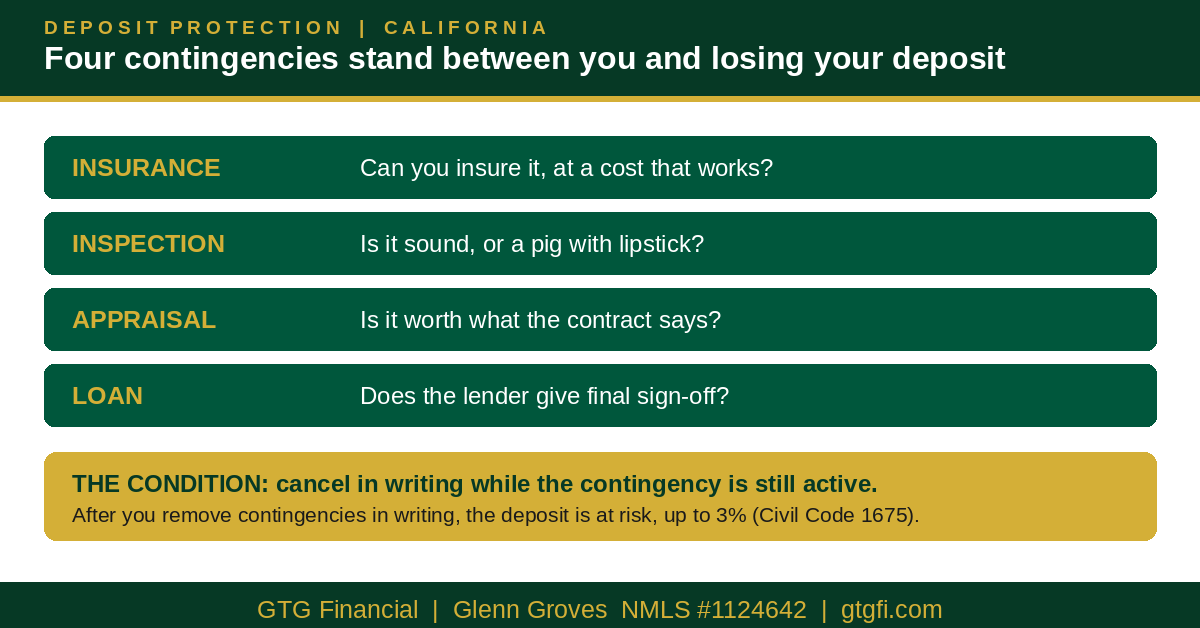
- Insurance contingency. Can you actually get homeowners insurance on this house, at a cost that works? In fire country, this one matters more every year.
- Inspection contingency. Get the property inspected. If there is a bunch of structural issues hiding under a fresh coat of paint, you want to know now.
- Appraisal contingency. The house has to be worth what we are saying it is. If the appraisal comes in low, the numbers have to be renegotiated or the deal changes.
- Loan contingency. Can we get final sign-off from the lender on your loan?
If one of those goes sideways, and you cancel under that still-active contingency, you get your deposit back from escrow. That is the system working exactly as designed.
The Condition Nobody Should Skip
Here is the sentence I want on the record, because the short version can be misread: the protection lasts while the contingency is still active, and you cancel in writing within its timeline.
California uses an active removal system. Your contingencies do not quietly expire on their own. You remove them, in writing, on a contingency removal form. And once you have removed them, you cannot un-remove them.
After all contingencies are removed, a buyer who walks away is in breach, and the deposit is genuinely at risk. Under the standard liquidated damages clause in a California residential purchase, for a 1-to-4 unit property the buyer intends to occupy, the seller may be entitled to keep up to 3% of the purchase price. That is not a scare tactic. It is why we treat every contingency removal as a real decision, with the inspections read, the appraisal in, insurance bound or confirmed, and loan sign-off clear, before anyone signs that form.
So the practical rules are simple:
- Never remove a contingency just because a deadline is close. Deadlines can be managed. Removals cannot be undone.
- Get your inspections, insurance quote, and appraisal answers inside the contingency windows. That is what they are for.
- If something goes wrong, act while the contingency is alive, in writing, with your agent. Do not assume a phone call protected you.
“
Once you have removed a contingency, you cannot un-remove it. That form is the moment you are all in.
GLENN GROVES, GTG FINANCIAL
The Bottom Line
Write the deposit check. It is protected, by design, through a set of contingencies that exist specifically so you can investigate the most expensive purchase of your life before you are fully committed.
Just respect the moment those protections come off, because that is the moment you are all in.
If you want your contingency dates and your loan timeline on one page before you write an offer, that is a standard part of how we set up a pre-approval.
Start here: 1595076.my1003app.com/1124642/register
Want your contingency dates mapped before you offer?
That is a standard part of how we set up a pre-approval: your deposit, your contingency windows, and your loan timeline on one page.
Start Hereor call (707) 546-0440
Glenn Groves
Mortgage Broker | GTG Financial | Santa Rosa, CA
NMLS #1124642 | gtgfi.com
GTG Financial, Inc. NMLS #1595076 | CA DRE #02029711. Equal Housing Opportunity. For educational purposes only. Not a commitment to lend. Subject to credit approval and underwriting. Rates and terms subject to change without notice. Individual rates vary based on credit profile, property type, occupancy, loan amount, and other factors. nmlsconsumeraccess.org

Related Posts