Introduction As Thanksgiving approaches, many homeowners find themselves balancing the joys of the season with…
First-Time Buyer Down Payment (3% Down)
July 2026 | GTG Financial | Santa Rosa, CA
First-Time Buyer Down Payment: How Little You Actually Need in Sonoma County
A first-time buyer in Sonoma County may need as little as 3% down on a conventional loan, or 3.5% on an FHA loan. On an $800,000 home, that is roughly $24,000 to $40,000, and the money can even come from a gift. Programs with the very lowest down payments can carry income limits, so the right fit is a strategy conversation.
Reviewed by Glenn Groves, Mortgage Broker, NMLS #1124642 · GTG Financial, Inc. NMLS #1595076 · Serving Sonoma, Marin, and the greater North Bay.
TL;DR: What’s in This Post
- The real minimum down payment: as low as 3%
- What that costs in dollars on a Sonoma County home
- Whether your down payment can be a gift (yes, with rules)
- The income-limit asterisk on the lowest-down programs
- 3% conventional vs 3.5% FHA vs 5% down, side by side
One of the biggest myths in home buying is that you need 20% down. For a first-time buyer in Sonoma County, the real number is a lot smaller, and there are several ways to cover even that. Here is what you actually need, in plain terms.
How Much Do You Really Need?
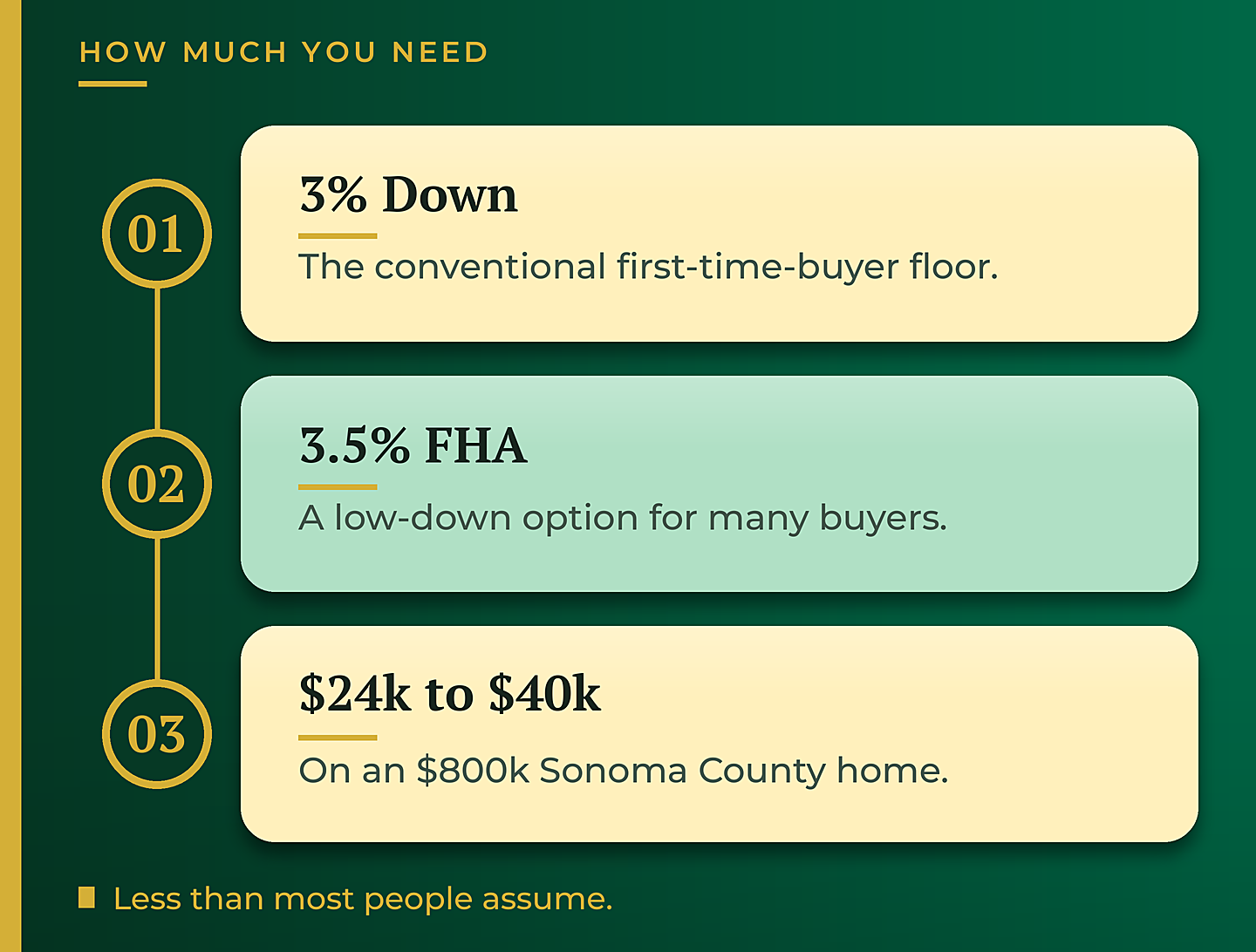
For a first-time buyer, a conventional loan can go as low as 3% down. FHA sits close behind at 3.5% down (with a credit score of 580 or higher) and is often a strong fit for buyers with a bit less saved or a lower credit score. Either way, you are a long way from 20%.
Put real numbers on it. Our average purchase price runs around $800,000. At 3% down that is about $24,000, and at 5% down it is about $40,000. So a reasonable planning range for a Sonoma County first-time buyer is roughly $24,000 to $40,000 for the down payment, plus closing costs. For a lot of people, that is far less than they assumed.
Can the Down Payment Be a Gift?
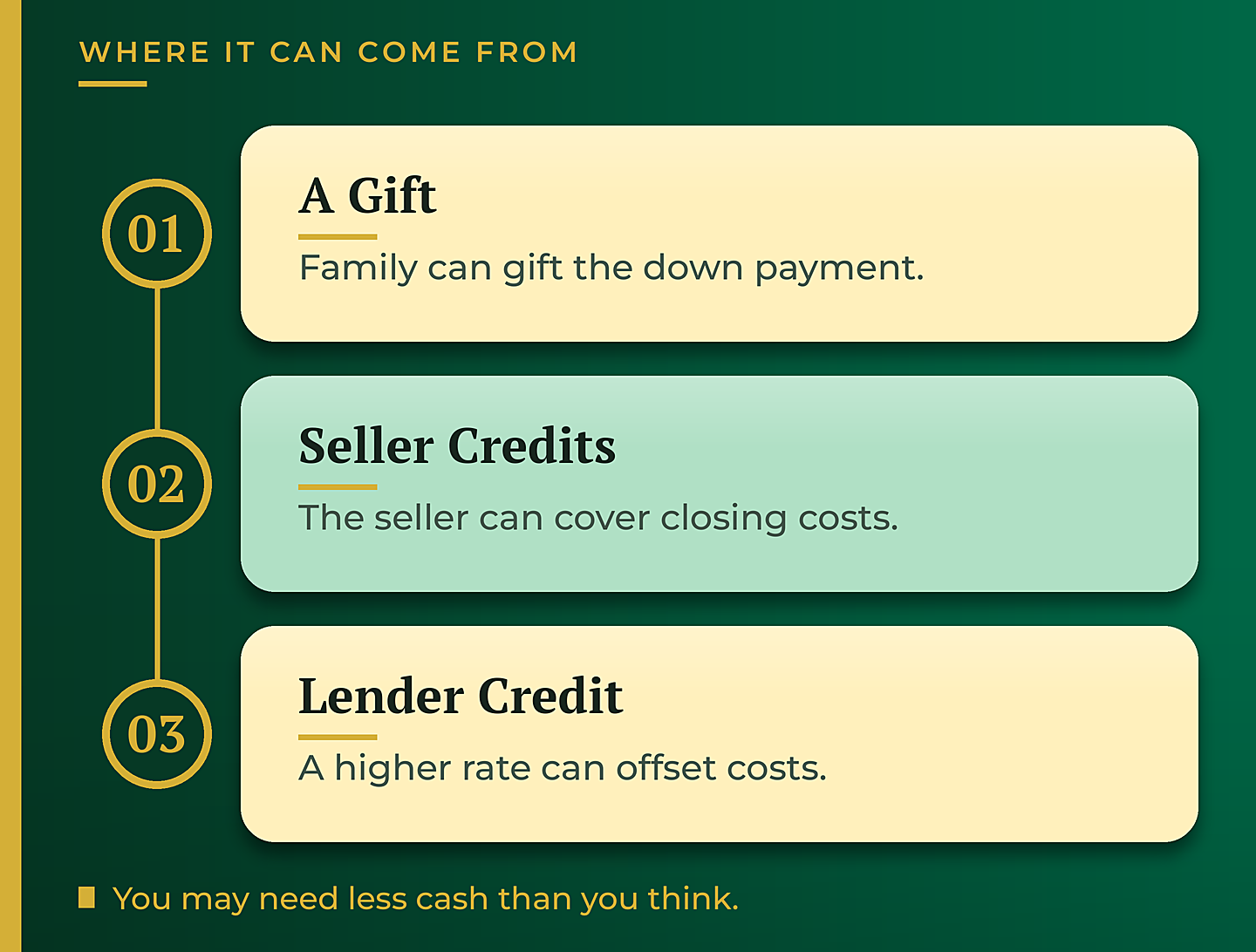
Yes, and this surprises a lot of buyers. On an FHA loan, 100% of the down payment can come from a gift. On a conventional loan for a one-unit primary residence, the entire down payment can also be gifted, with no requirement that any of it be your own money. (The rule that you must put in some of your own funds generally applies to two-to-four-unit properties and second homes, not a single-family home you will live in.)
There are rules that make a gift count. The money has to come from an eligible donor, generally a family member, and on conventional loans that can also include a fiance, domestic partner, or godparent. It cannot come from someone with a stake in the sale, like the seller or agent. And it needs a paper trail: a signed gift letter stating it is not a loan, plus documentation of the transfer. Beyond gifts, a seller can contribute toward your closing costs, and you can even take a slightly higher interest rate so the lender covers some costs. Between those levers, the cash you personally need can be smaller than the sticker number suggests.
The Asterisk: Income Limits on the Lowest-Down Programs
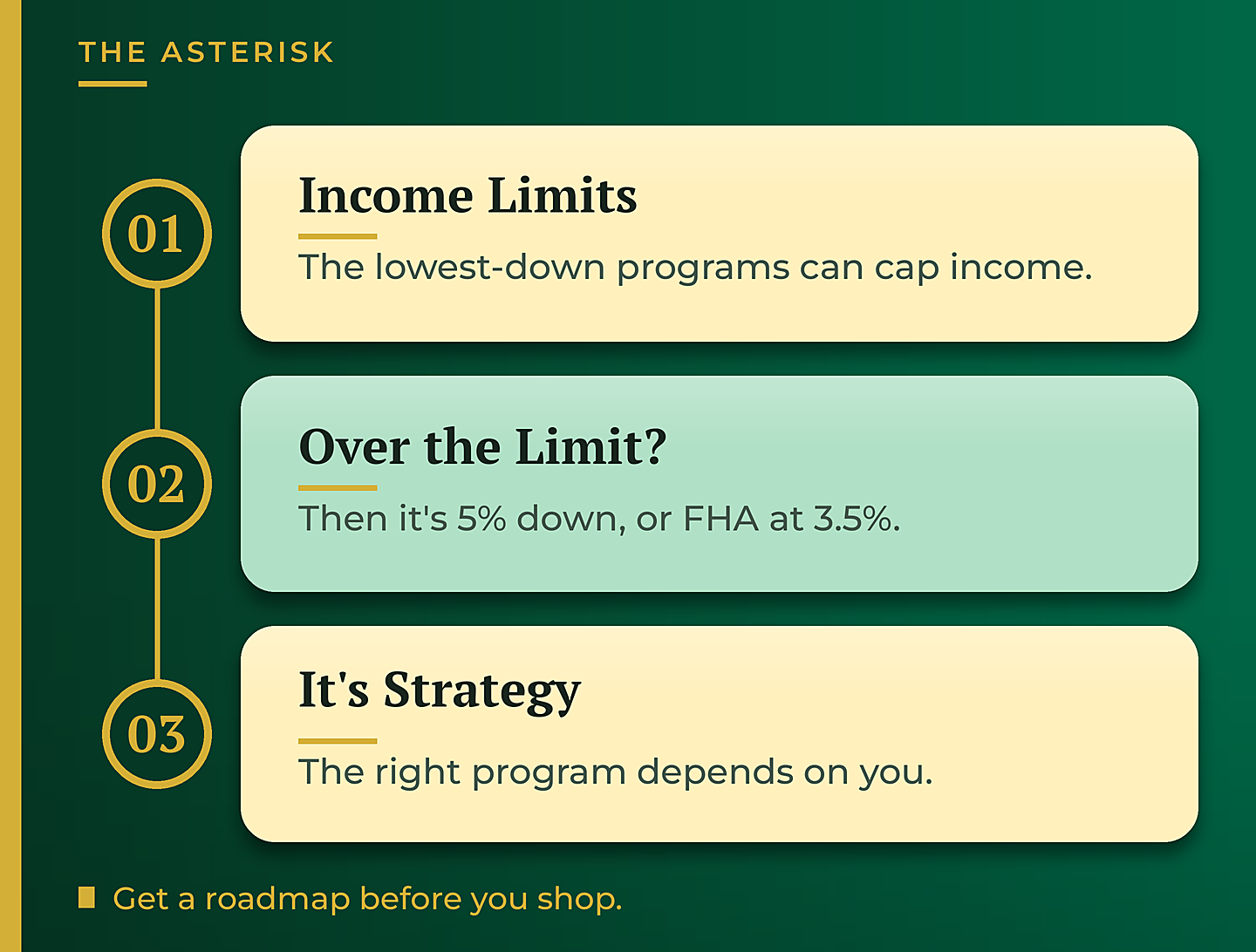
Here is the honest asterisk, and it is worth getting right. Some 3% down conventional programs, such as Fannie Mae’s HomeReady and Freddie Mac’s Home Possible, carry a household income limit tied to the area median income for the county. In exchange for staying under that limit, those programs reward you with reduced mortgage insurance. The limits are set by the program, update periodically, and differ by county, so check the current figure for your household rather than rely on a number you saw online.
But being over an income limit does not mean you suddenly need more money down. Other 3% down programs, like the standard Conventional 97 and Freddie Mac’s HomeOne, have no income limit at all. So a higher earner can usually still put just 3% down; they simply give up the discounted mortgage insurance that the income-limited programs offer, not the low down payment. FHA at 3.5% down is another route with no income cap. That is exactly why this is a strategy conversation: the income limits mostly affect which program and what pricing you get, not whether you can buy with a little down.
3% Conventional vs 3.5% FHA vs 5% Down
Here is a simple side-by-side of the common low-down-payment paths for a first-time buyer.
| 3% Conventional | 3.5% FHA | 5% Conventional | |
|---|---|---|---|
| Down payment | 3% | 3.5% | 5% |
| On an $800k home | About $24,000 | About $28,000 | About $40,000 |
| Income limit | Some programs only (not all) | No income limit | No income limit |
| Down payment gift | Can be 100% gift | Can be 100% gift | Can be 100% gift |
| Good fit for | Lower income, strong credit | Lower credit or less saved | Higher income buyers |
Dollar figures are illustrative examples based on an $800,000 price and do not include closing costs or reserves. Program terms, income limits, and mortgage insurance vary by loan type and change over time. Rates and program details shown are illustrative only and do not represent current available terms. Contact Glenn Groves for details specific to your situation.
When to Start
The single best move is to start early, before you are ready to buy. So much of this is situational: maybe you have a gift waiting in the wings, maybe a seller credit is on the table, maybe FHA with a lender credit toward closing costs is the smart play. You cannot see those levers until someone maps them to your specific numbers.
It is never too early to get a game plan and a roadmap. When you do, most first-time buyers find they are a lot closer to buying than they thought.
Frequently Asked Questions
How much do first-time buyers need to put down?
As little as 3% on a conventional loan or 3.5% on an FHA loan. On an $800,000 Sonoma County home, that is roughly $24,000 to $40,000 depending on the program, plus closing costs.
Can my down payment be a gift?
Yes. On FHA loans and on conventional loans for a one-unit primary residence, the entire down payment can come from a gift. The gift must be from an eligible donor, usually a family member, and documented with a gift letter and proof of transfer.
Is there an income limit for 3% down?
Some 3% down programs have one and some do not. Income-limited programs like HomeReady and Home Possible cap household income at 80% of the area median income and reward it with cheaper mortgage insurance. Standard 3% down programs like Conventional 97 and HomeOne have no income limit. So a higher earner can usually still put 3% down, just without the discounted mortgage insurance.
Is FHA or conventional better for a low down payment?
It depends. FHA at 3.5% down can be a better fit for lower credit or less savings, while a 3% conventional loan can work well for buyers with strong credit who fit the program. The right choice is a strategy decision based on your specific numbers.
The Bigger Picture
The 20%-down myth keeps a lot of people renting who could already own. The real minimum for a first-time buyer is far lower, the money can come from a gift, and there is almost always a structure that fits. The key is knowing your options before you start shopping.
If you want to see exactly what you would need for your situation, reach out and we will build you a roadmap, no pressure, just a clear picture of where you stand.
Glenn Groves
Mortgage Broker | GTG Financial | Santa Rosa, CA
NMLS #1124642 | gtgfi.com
This article is for educational purposes and is not financial advice. Down payment minimums, income limits, mortgage insurance, gift-fund rules, and program terms vary by loan type and borrower and change over time, and all financing is subject to credit approval and underwriting. Dollar amounts are illustrative examples based on an $800,000 price. Rates shown are for illustrative purposes only and do not represent current available rates. Contact Glenn Groves for current program and rate information. Glenn Groves NMLS #1124642 | GTG Financial, Inc. NMLS #1595076 | CA DRE #02029711. Equal Housing Opportunity. Not a commitment to lend. nmls consumeraccess.org

Related Posts