Introduction As Thanksgiving approaches, many homeowners find themselves balancing the joys of the season with…
80/10/10 Piggyback Loan (Petaluma Deal Deep Dive)
July 2026 | GTG Financial | Santa Rosa, CA
80/10/10 Loan: How We Beat PMI and a Jumbo Rate on a $1M Petaluma Home
An 80/10/10 loan is a piggyback structure: a first mortgage for 80% of the price, a second mortgage for 10%, and 10% down. On a $1 million Petaluma purchase, it let our buyer keep a conforming first mortgage, skip mortgage insurance, and avoid an ugly 10%-down jumbo loan.
Reviewed by Glenn Groves, Mortgage Broker, NMLS #1124642 · GTG Financial, Inc. NMLS #1595076 · Serving Sonoma, Marin, and the greater North Bay.
TL;DR: What’s in This Post
- Why 10% down on a $1M home lands you in jumbo territory
- How an 80/10/10 splits the loan to stay conforming
- How the structure skips mortgage insurance
- The one tradeoff: a small subordination bump
- An 80/10/10 vs a 10%-down jumbo, side by side
Here is a real Petaluma deal that shows how loan structure can save a buyer real money. The client was buying a $1 million home and had 10% to put down. On paper that sounds fine, but in Sonoma County it walked them straight into the jumbo loan trap. Here is how we structured around it.
The Problem: 10% Down Pushed Them Into Jumbo
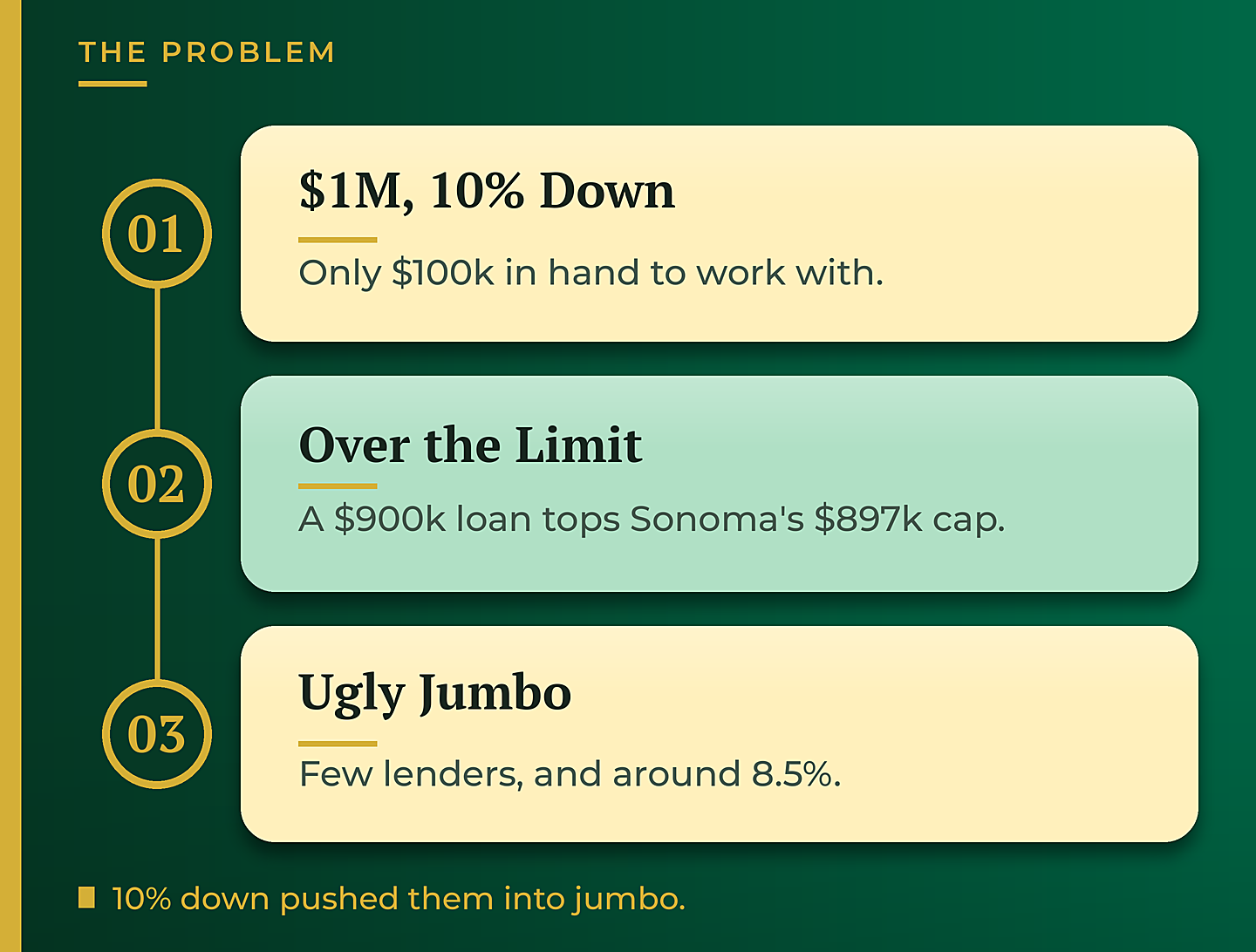
The buyer had $100,000 to work with on a $1 million purchase. Here is the math that creates the problem: 10% down on a $1 million home leaves a $900,000 loan. That is above Sonoma County’s high-balance conforming limit of $897,000, which tips the entire loan into jumbo territory.
And a 10% down jumbo is not a friendly place to be. Very few lenders will do one, and the ones that do want your left arm at the same time. We were looking at something like an 8.5% interest rate, and the terms were ugly. For a strong buyer, that is a bad outcome driven entirely by loan size, not by their finances.
The Fix: An 80/10/10 Piggyback Loan
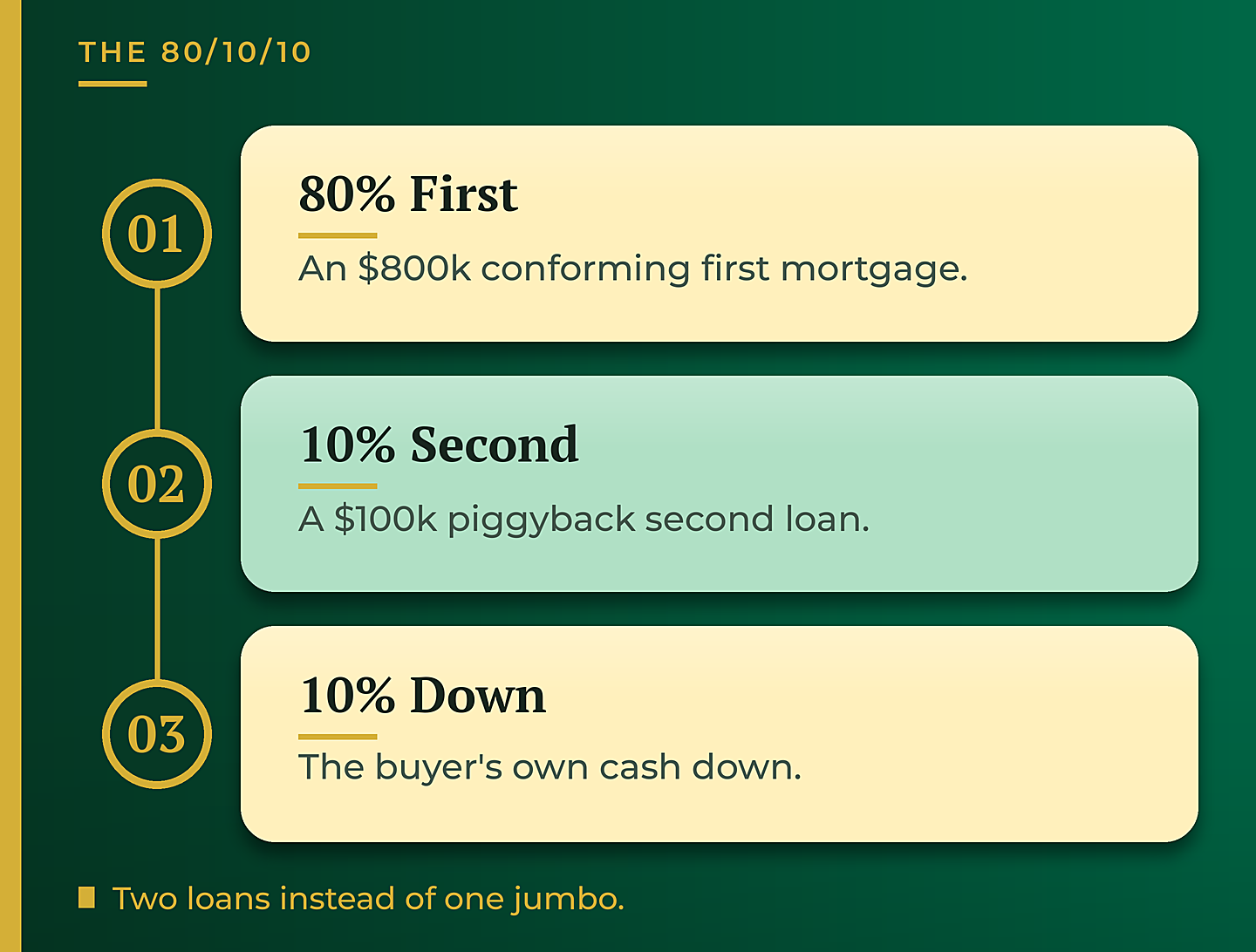
Instead of one oversized loan, we split it. The buyer put 10% down, we took out a first mortgage of $800,000, and we added a $100,000 second on top. That is where the name comes from: 80% first, 10% second, 10% down, an 80/10/10.
The magic is in how the first-mortgage lender sees it. Because there is a 10% second sitting behind it plus the 10% down, the first mortgage is effectively a 20%-down loan of $800,000, which lands right under the conforming limit. So the biggest chunk of the financing gets normal conforming pricing instead of jumbo pricing.
The Payoff: No Mortgage Insurance, Better Pricing
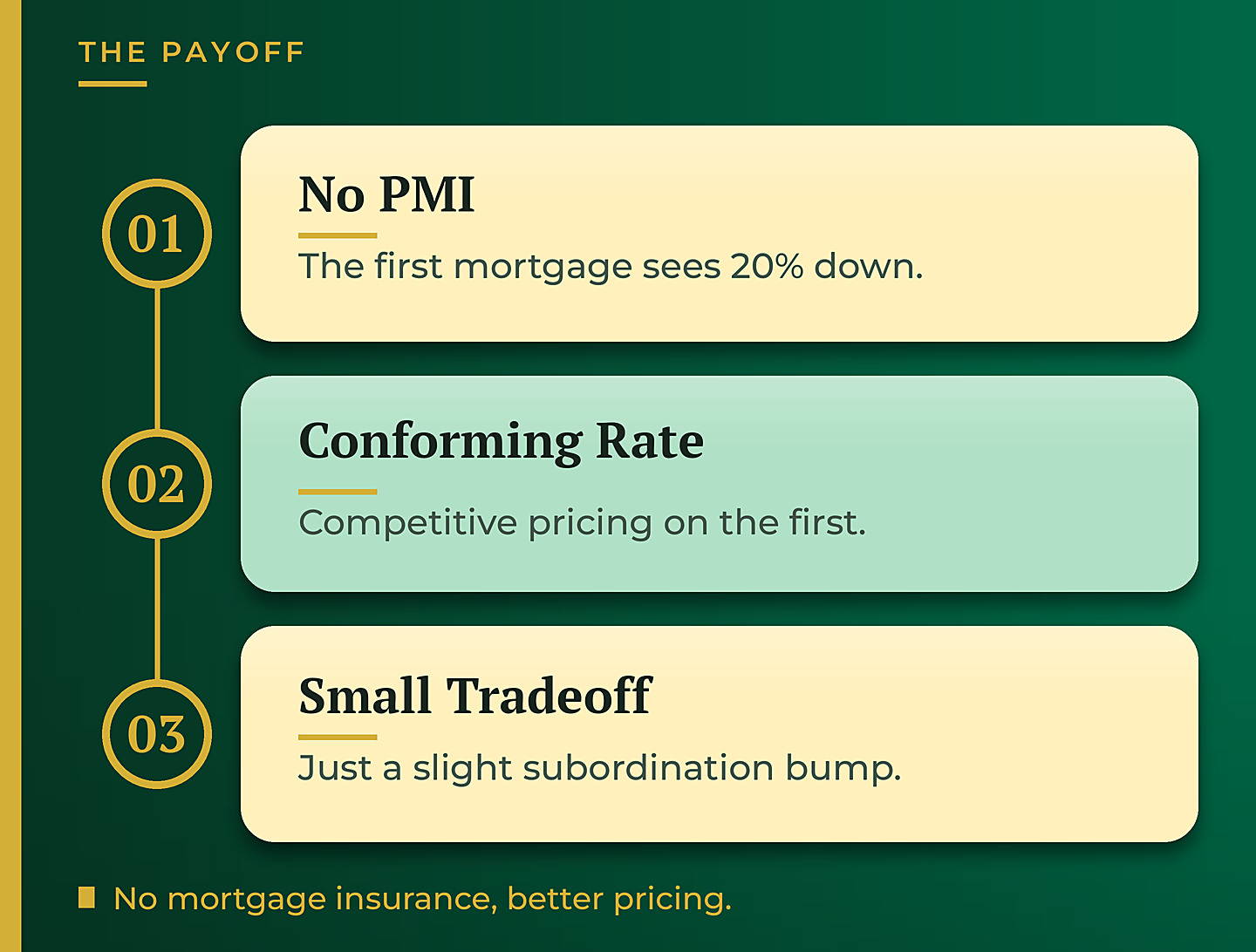
Because the first mortgage looks like a 20%-down loan, there is no mortgage insurance. That alone is a meaningful monthly savings versus a low-down-payment structure. The only thing we had to contend with is what is called subordination, which is a small pricing adjustment on the first mortgage because there is a second loan behind it. On this deal that meant roughly an eighth to a quarter higher in rate, a minor cost.
When we laid it next to the alternative, it was not close. We showed the client the 80/10/10, which does come with two payments, right beside a 10% down jumbo. They looked at the jumbo and said, that is a joke. It worked out great: a first and second payment, no mortgage insurance, and a competitive rate because the large first mortgage was conforming.
80/10/10 vs a 10% Down Jumbo
For a buyer just over the conforming line without a full 20% down, the comparison usually looks like this.
| 80/10/10 Piggyback | 10% Down Jumbo | |
|---|---|---|
| Loan structure | $800k first + $100k second | One $900k jumbo loan |
| First mortgage pricing | Conforming, competitive | Jumbo, around 8.5% on this deal |
| Mortgage insurance | None | Depends on lender and terms |
| Lender availability | Widely available | Very few lenders |
| Payments | Two (first and second) | One |
This is a real deal example shared for educational purposes. Individual results, structures, and terms vary by borrower and situation. Rates and figures shown, including the roughly 8.5% jumbo rate, are illustrative only and do not represent current available rates. Contact Glenn Groves for current rate information.
When a Piggyback Loan Makes Sense
Piggybacks are not for everyone, and there are several ways to build them: an 80/10/10, an 80/15/5, a 75/15/10, and others, depending on your down payment and goals. The time we really reach for one is to get a buyer out of the jumbo space when they do not already have a full 20% of their own money to put down.
There is a logistics tradeoff. Because there are two loans, there can be two underwrites, so these deals sometimes need a little more time. On this Petaluma purchase we asked for a standard timeline, set expectations up front, and it closed cleanly. When the structure fits, it is one of the more powerful tools a broker can bring to a North Bay buyer.
Frequently Asked Questions
What is an 80/10/10 loan?
It is a piggyback structure made of a first mortgage for 80% of the price, a second mortgage for 10%, and 10% down from the buyer. Splitting the financing this way can keep the large first mortgage at a conforming loan size.
How does an 80/10/10 avoid mortgage insurance?
Because a 10% second and 10% down sit behind the first mortgage, the first-mortgage lender treats it like a 20%-down loan. At 20% down there is typically no mortgage insurance required on that first mortgage.
What is a piggyback loan?
A piggyback loan is a second mortgage taken out at the same time as the first, used to bridge the gap between your down payment and the amount needed to keep the first mortgage at a favorable size. An 80/10/10 is the most common version.
When does a piggyback loan make sense?
It makes the most sense when a buyer is just over the conforming loan limit and does not have a full 20% down, and would otherwise be pushed into a jumbo loan. It can also be structured in several ways depending on the down payment.
The Bigger Picture
This Petaluma deal is a good reminder that how a loan is structured can matter as much as the rate itself. The buyer’s finances never changed. What changed was the structure, and that is what kept them out of an ugly jumbo and saved them from mortgage insurance.
If you are buying near the top of Sonoma County’s conforming limit and do not have a full 20% down, an 80/10/10 may be worth a look. Reach out and we will run your numbers and compare the structures side by side.
Glenn Groves
Mortgage Broker | GTG Financial | Santa Rosa, CA
NMLS #1124642 | gtgfi.com
This article describes a real deal example shared for educational purposes and is not financial advice. Individual results, loan structures, and terms vary by borrower and situation, and all financing is subject to credit approval and underwriting. Rates shown, including the roughly 8.5% jumbo rate referenced, are for illustrative purposes only and do not represent current available rates. Contact Glenn Groves for current rate information. Glenn Groves NMLS #1124642 | GTG Financial, Inc. NMLS #1595076 | CA DRE #02029711. Equal Housing Opportunity. Not a commitment to lend. nmls consumeraccess.org

Related Posts