BUYER PLAYBOOK · GTG FINANCIALOctober 2026 · Santa Rosa, CA WATCH THE 73-SECOND VERSIONWatch on…
Why You Sign Disclosures Even If They Are Wrong
| LOAN PROCESS · GTG FINANCIALOctober 2026 · Santa Rosa, CA |
WATCH THE 62-SECOND VERSION
TL;DR: WHAT’S IN THIS POST
- What your signature on initial disclosures actually means: you received them, nothing more
- Why the first numbers are almost never exact: escrow, insurance, and tax figures may not be final yet
- What to do when a number is flat wrong: sign the acknowledgment, then flag it to me so it gets corrected
- Where the numbers that actually bind you show up: your final Closing Disclosure
The Packet That Scares Everybody
Early in every loan, a big packet lands in your inbox: initial disclosures, including a Loan Estimate with a payment that does not match the conversation we just had.
And every borrower has the same reaction: “Why is the payment $100 higher? I am not signing something that is wrong.”
I get it. And I am going to say the key line twice, the same way I say it in the video: you have to acknowledge you have seen it, even if it is incorrect. Acknowledging is not agreeing.
What the Form Itself Says
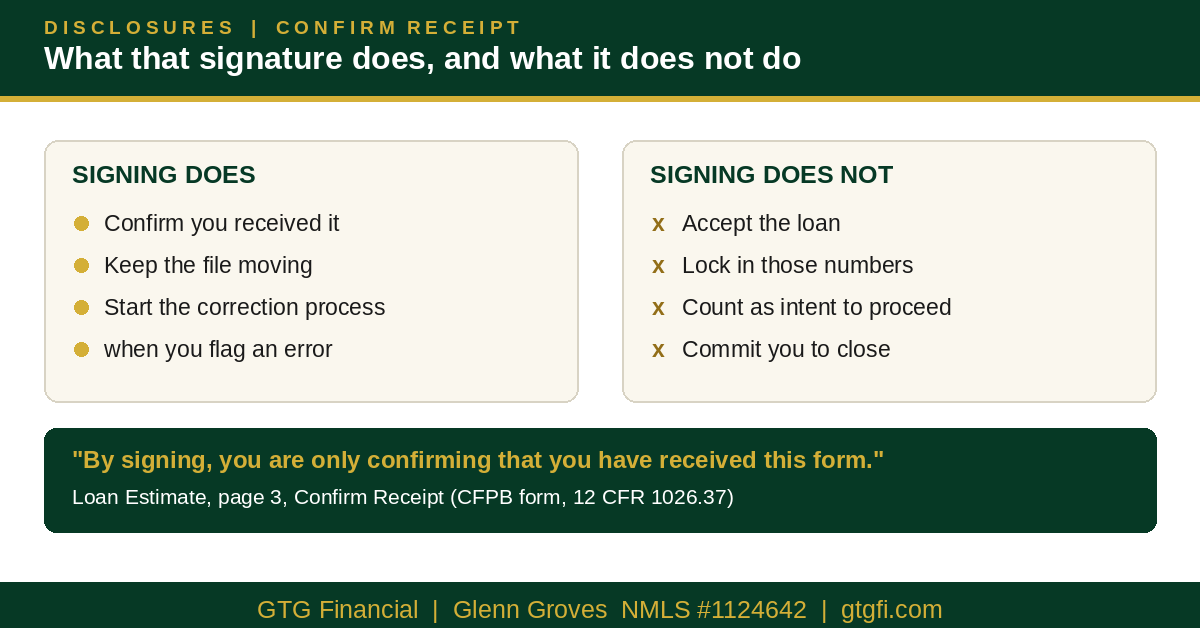
This is not just my explanation. Look at the signature section on page 3 of the Loan Estimate. Under “Confirm Receipt” it reads, in the federal form’s own words:
“By signing, you are only confirming that you have received this form. You do not have to accept this loan because you have signed or received this form.”
That is the Consumer Financial Protection Bureau’s standard form (12 CFR 1026.37). A signature there documents receipt. Under the federal rules, a signature on a Loan Estimate does not even count as your intent to proceed with the loan. That is a separate step.
So when you e-sign the initial packet, all you are telling the lender is: the borrower has seen it. You are not committing to those numbers, that payment, or that loan.
“
You have to acknowledge you have seen it, even if it is incorrect. Acknowledging is not agreeing.
GLENN GROVES, GTG FINANCIAL
Why the Numbers Are Off in the First Place
Those initial disclosures are built off the information given to the lender at application, and at that point some of it is not final:
- Escrow and title may not have given their final figures yet.
- Insurance may be an estimate, or, my favorite example from real files, someone fat-fingers the insurance at $500 a month when you and I both know it is not that much.
- Taxes may be estimated off a rule of thumb until the real parcel numbers are in.
The lender still has to issue disclosures on a legal timeline, so they issue them with the best numbers they have. Then, as the real figures arrive, the estimates get corrected on revised disclosures through the process.
What I Need You to Do With a Wrong Number
Two things, in this order:
- Sign the acknowledgment so the file keeps moving. An unsigned packet stalls everything downstream, and the timelines in a purchase contract do not pause while we admire the problem.
- Flag the wrong number to me, specifically. Tell me which line, and what you think it should be. “They fat-fingered the insurance” is a perfect flag. I will tell you why it is incorrect, confirm what the right figure is, and make sure the correction works its way into the file. Sometimes lenders get a little squirrely in the middle of a file and have to be corrected. That is normal, and it is literally part of my job.
What not to do: ignore a number you know is wrong because “Glenn said signing does not matter.” Signing does not lock you in, but silence lets a wrong estimate drift further down the line than it should.
The Document That Does Deserve Your Full Stop
Late in the process you get the Closing Disclosure, at least three business days before closing. That one carries the final terms and cash to close, and that is the document to read line by line against your Loan Estimate and ask me about anything that moved.
Initial disclosures: acknowledge receipt, flag errors to me, keep the file moving. Final Closing Disclosure: verify everything.
That is the whole distinction, and once you know it, that first big packet gets a lot less scary.
In the middle of a loan and staring at a packet right now? Forward it to me and point at the line that looks wrong. We will walk it.
Start an application here: 1595076.my1003app.com/1124642/register
Staring at a disclosure packet right now?
Forward it to me and point at the line that looks wrong. We will walk it, fix what needs fixing, and keep your file moving.
Start Hereor call (707) 546-0440
Glenn Groves
Mortgage Broker | GTG Financial | Santa Rosa, CA
NMLS #1124642 | gtgfi.com
GTG Financial, Inc. NMLS #1595076 | CA DRE #02029711. Equal Housing Opportunity. For educational purposes only. Not a commitment to lend. Subject to credit approval and underwriting. Rates and terms subject to change without notice. Individual rates vary based on credit profile, property type, occupancy, loan amount, and other factors. nmlsconsumeraccess.org

Related Posts